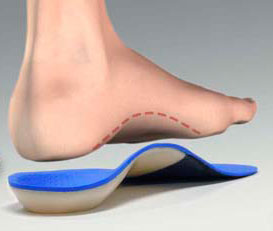
Why All Custom Orthotics Are NOT the Same
The foot arch support industry is a multi-billion-dollar business, which is why there are so many products on the market.
But here’s the truth:
Not all arch supports—and not even all “custom” orthotics—are the same.
Why a True Custom Orthotic Is NOT the Same as an OTC Arch Support
The term “orthotic” is often used loosely—but it shouldn’t be.
A true orthotic is not something you pick up off the shelf. It is a custom-made device, created from an impression of your foot, designed to guide and improve how your foot functions during walking.
That’s what separates it from an over-the-counter (OTC) arch support, which should never be described as an orthotic. Orthotics are custom; OTC arch supports are not!
What Is a True Orthotic?
A true custom orthotic is:
- Made individually for each foot
- Designed to improve biomechanics (how your foot moves)
- Built to stabilize and guide the foot through the gait cycle
It does more than provide support—it changes how your foot works.
A properly made orthotic can:
- Guide your foot from heel strike to push-off
- Support proper motion of the big toe joint
- Reduce stress on the feet, knees, hips, and lower back
This is why custom orthotics address the cause of pain, not just the symptoms.
What Is an OTC Arch Support?
An OTC arch support is:
- Mass-produced
- Come in mirror-matched images
- Based on an “average” foot
- Designed mainly for cushioning
It does not:
- Account for your individual structure
- Correct abnormal movement
- Improve gait mechanics
At best, it may provide temporary comfort.
At worst, it can reinforce poor movement patterns and, over time, in many cases, make feet worse, not better.
Why the Terminology Matters
Calling an OTC insert an “orthotic” is misleading.
👉 An arch support supports
👉 An orthotic guides and improves function
When devices are mislabeled, people often expect long-term results—but don’t get them.
In many cases, people think that orthotics don’t work. The reality is that a true orthotic was never used. It’s confusing because of the marketing used to sell the OTC devices.
Do You Need a Prescription?
Many people believe a doctor’s prescription is required.
In most cases, it is not.
A prescription is typically only needed if:
- You are using insurance, and
- The insurance company requires it
What matters more is the training of the person evaluating your feet.
A Certified Pedorthist (C-Ped) is trained in:
- Foot anatomy and pathology
- Biomechanics
- Orthotic design and fitting
How Custom Orthotics Are Made
An orthotic is only as good as the impression used to make it.
Common methods include:
Plaster or Slipper Casting
- Non-weight-bearing
- Captures the foot in a neutral position
- Requires proper technique
Foam Box Impressions
- Quick and widely used
- Can be effective when done correctly
- Accuracy depends on proper positioning
⚠️ If done improperly—especially in a standing position—it can flatten the arch and distort the impression. If done correctly, it can improve balance and stability, enhance biomechanical function, and make one more stable and able.
3D Digital Scans
- Fast and clean
- Typically weight-bearing
- May capture the foot in a collapsed position
At the WalkEZstore, we do not recommend this type of foot impression process unless scanning biomechanically enhanced plaster foot molds is used.
Why the Impression Method Matters
The goal of a functional orthotic is not just to match your foot, but to improve how it functions.
That requires:
- Proper positioning during the impression process
- Support at key structures (like the sustentaculum tali)
- Freedom of motion at the big toe joint
If the foot is captured in a collapsed position, the custom orthotic will reproduce that same problem.
A Better Approach
A biomechanically focused impression method positions the foot more appropriately from the start.
This allows the orthotic to:
- Guide movement more efficiently
- Create the stage for rehabilitation
- Improve function over time
- Reduce stress throughout the body
The Bottom Line
Not all custom orthotics are the same.
The difference comes down to:
- How the impression is taken
- How the device is designed
- Whether it improves function or simply adds cushioning
Choose carefully; this is a buyer-beware situation. Know exactly what you are spending your hard-earned money on—because your feet should carry you for life.
Walk Better. Feel Better.
When your feet are properly supported and aligned, everything above them works better, and you feel better, because… when your feet feel good, you feel good!