
Foot gait analysis is a professional assessment of how your feet and body move while in motion. It examines your walking pattern, arch type, pressure distribution, pronation and supination, and identifies movement imbalances that may contribute to discomfort or pain in the feet, heels, knees, hips, or lower back. We use either traditional pedograph foot pressure analysis or AI-powered video gait analysis to assess your foot mechanics, depending on your individual desires. These insights help us provide you with the most appropriate supportive footwear, custom orthotics, and foot care needs. With a Certified Pedorthist doing your foot gait analysis, you can be assured that you are receiving the best plan to reach your goals for better foot health.

Your gait is the way your feet and body move with every step, from the moment your heel touches the ground all the way to pushing you into the next step. Small changes in this movement, such as overpronation, excessive supination, uneven pressure distribution, or poor foot alignment, can affect how your body absorbs shock and transfers force. Over time, these imbalances may place extra stress on your feet, ankles, knees, hips, and lower back.
Many people experience heel pain, tired feet, knee discomfort, or recurring injuries without realizing that the way their feet move while walking or running may be contributing to their discomfort. A foot gait analysis, also known as a biomechanical or walking assessment, helps identify these movement patterns. This allows us to recommend the right custom orthotic fit, insoles, and supportive footwear based on your individual foot mechanics, rather than relying solely on shoe type, size, and your comfort.
Your heel meets the ground first, absorbing initial impact.
Your foot rolls forward, and the arch absorbs shock as weight shifts over it. At this stage, your foot is in full-foot contact with the floor or terrain under it.
Weight transfers to the ball of your foot as you push off into the next step.
Your leg swings forward to begin the next step.
Did you know you have 3 arches in your foot? The medial arch or the curved structure along the inside of your foot, the lateral arch or the smaller curved part on the outside, and the transmetatarsal arch, which is up by your toe joints. All 3 of these arches help to support your body weight and absorb impact during movement.
There are generally 3 arch types: Pes Flat or Low, Pes Medium or Neutral, and Pes Cavus or High. The height and flexibility of your arches can influence how pressure is distributed through your feet with each step you take. However, arch type alone does not determine whether you need treatment; it is just one part of understanding how your particular arch type functions as you walk or run.
Generally, foot arches are grouped into three main types:

Little to no visible curve along the inside or outside of the foot. The entire sole tends to make contact with the ground, which can be, but is not always, linked to overpronation.

A moderate curve along the inside and outside of the foot where the weight is generally distributed evenly, with a natural, controlled amount of pronation and supination.
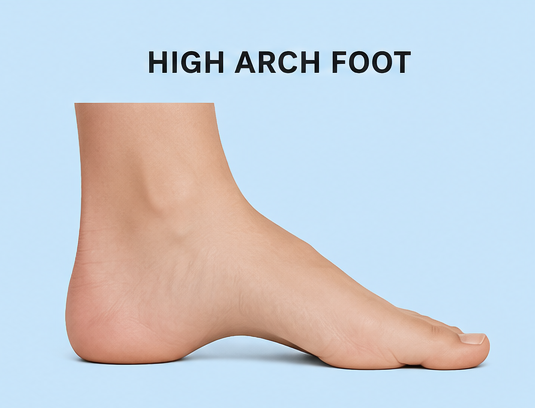
A pronounced curve on the inside and outside of the foot, with only the heel and forefoot bearing most of the contact. It is often linked to underpronation or supination. This is exactly what a wet-foot test — or a pedograph print — reveals: the shape your foot leaves behind tells us which category of arch type you fall into.
This is exactly what a wet-foot test — or a pedograph print — reveals: the shape your foot leaves behind tells us which category you fall into.
Pronation is the natural inward roll of your foot after your heel strikes the ground. It's a normal, necessary part of the gait cycle that helps absorb shock, allows the foot to find the terrain under it, and distributes weight evenly through the foot as you move. Problems tend to arise when the foot rolls in too much (overpronation) or not enough (underpronation or too much supination)

The foot rolls inward slightly (about 15%) after heel strike, absorbing shock efficiently before pushing off evenly through the ball of the foot and toes.

The foot rolls inward more than usual, often linked to flatter arches. But even a high arch can have too much pronation value. Over time, this can add strain to the arch, ankle, knee, hip, and lower back.

The foot rolls outward rather than inward, which is more common with higher arches. This foot type may have short ligaments and tendons, reducing range of motion, or may result from tight muscles in the calves and feet. This can reduce natural shock absorption through the foot and leg and generally causes the foot to walk on the outside of it. Over time, this foot type can cause serious knee, hip, and back issues and is prone to lateral ankle sprains.
Arch type and pronation are closely linked: flatter arches tend toward overpronation, while higher arches tend toward underpronation. Neither condition requires correction unless in pain, but both benefit from proper support, which helps maintain good foot alignment, improved mobility, and better health.
The running gait follows the same basic cycle as walking, but with one key difference: a flight phase, where both feet briefly leave the ground at once. That single difference changes everything about the forces moving through your feet. Running gait also shifts with speed, incline, fatigue, and footwear. This is why a dynamic, in-motion assessment is so valuable. This is exactly why we use the AI Running Form & gait analysis tool, which uses a quick 10 to 20 second smartphone video to capture these real-time shifts, analyze your unique movement patterns, and give us the data needed to optimize your run.
Remember, running puts 10 times your body weight on each foot as it connects with the ground and can cause several different issues with the body as it moves. This is why the proper shoe fit and level of support are important in maintaining a healthy gait throughout your running years. It is known that a runner has a running life expectancy of 40-50 years if he or she is lucky enough to be able to maintain foot, knee, hip, and back health for that long. As a runner reaches the end of their running years, it is completely acceptable to move into light jogging or a fast-paced walking program to maintain the sport they have long enjoyed. This is, of course, as long as their body is in a good and healthy condition.
Where your foot first contacts the ground while running has a big effect on how impact travels through your body.
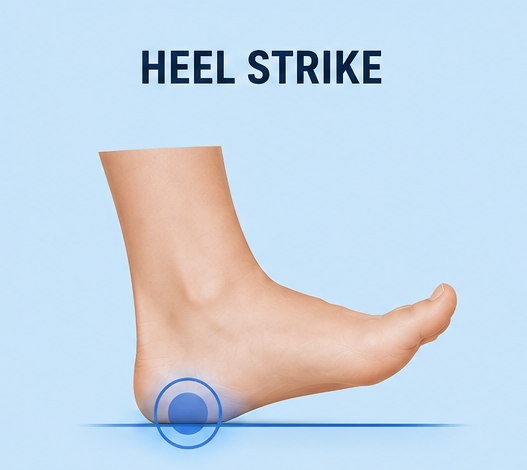
The heel makes first contact. Common in casual runners, often paired with cushioned heel support to manage impact.

The middle of the foot lands first, spreading impact more evenly between the heel and forefoot.

The ball of the foot lands first, common among sprinters and some experienced distance runners.
Because running gait happens fast and changes with speed, fatigue, and terrain, it's often best captured in motion, which is exactly where our real-time AI video analysis stands out for runners.
You may benefit from a professional gait or walking assessment if you experience any of these issues, whether you walk, run, stand for work, or simply want to move with more comfort and confidence.
A gait analysis isn't just for people in pain. It can also reveal movement patterns that may contribute to future issues, giving you the chance to address them early with the right footwear, custom orthotics, or exercise guidance to gain and maintain good muscle strength and function.
Your movement matters, and our approach reflects that. Whether you choose a traditional and dynamic pedograph pressure assessment or an AI Running Form & Gait Analysis, your care is guided by decades of clinical experience and a commitment to personalized orthotic solutions and proper shoes to help you reach and maintain your goals.
Kathy Carandang holds a National Board Certification in Pedorthics, specializing in foot biomechanics, custom orthotic fabrication, and footwear solutions. Her qualifications allow her to assess, fit, support, and modify footwear for one’s individual needs.
Thousands of foot assessments performed, spanning every age group and activity level. Her years of experience can reassure you that you are receiving the utmost care and education about your feet. Yes, she will not only care for your feet but help you understand the individuality of your own unique pair and how to best fit and care for them while meeting your goals.
No two feet are exactly the same. Even if they measure the same, they will not function exactly the same. Every recommendation is based on your specific gait, arch type, and lifestyle needs.
We recommend what you actually need, whether that's custom orthotics, better footwear, or simply peace of mind, teaching you how best to care for your unique pair of feet.
We offer two advanced assessment methods that serve distinct clinical goals and can be used individually or together, depending on your specific requirements and desires. While the traditional pedograph captures a precise static pressure impression of your foot, our AI-powered analysis allows for dynamic biomechanics in motion over several steps. Here is what each process involves, so you know exactly what to expect from your assessment.
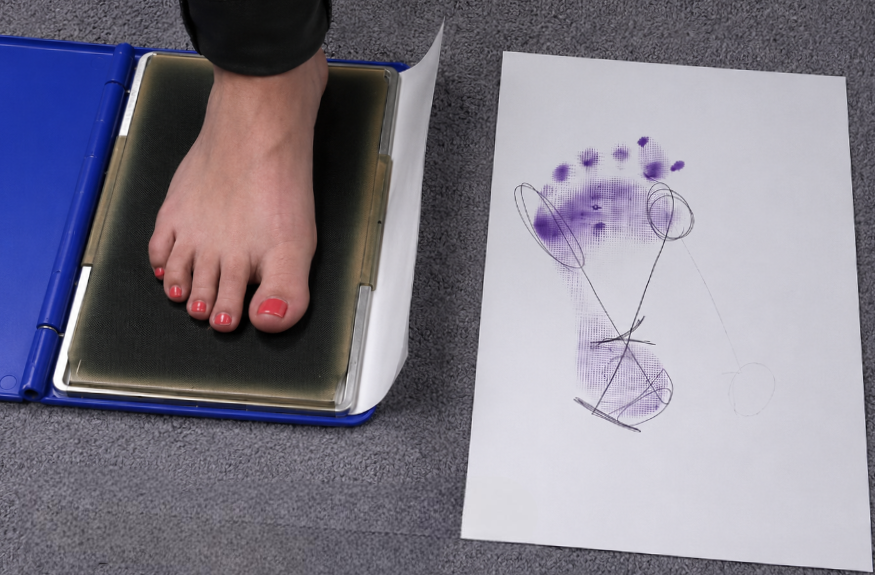
The pedograph is a hands-on foot pressure analysis tool that pedorthists have relied on for decades. The pedograph captures a static pressure impression of your feet while standing or stepping onto a pressure-sensitive pad, revealing your arch type and how your weight is distributed throughout your step. It also shows pressure points of possible pain and how the professional pedorthist can offload those areas for more comfort.
Available in-store and long distance · Ask our team about current pricing.
This type of gait analysis uses video vision and artificial intelligence to analyze walking or running mechanics. Instead of a single static print, it captures your gait in motion over several steps, analyzing all lower extremity joint angles, foot strike patterns, and stride, all in real time.
Available in-store · Ask our team about current pricing.
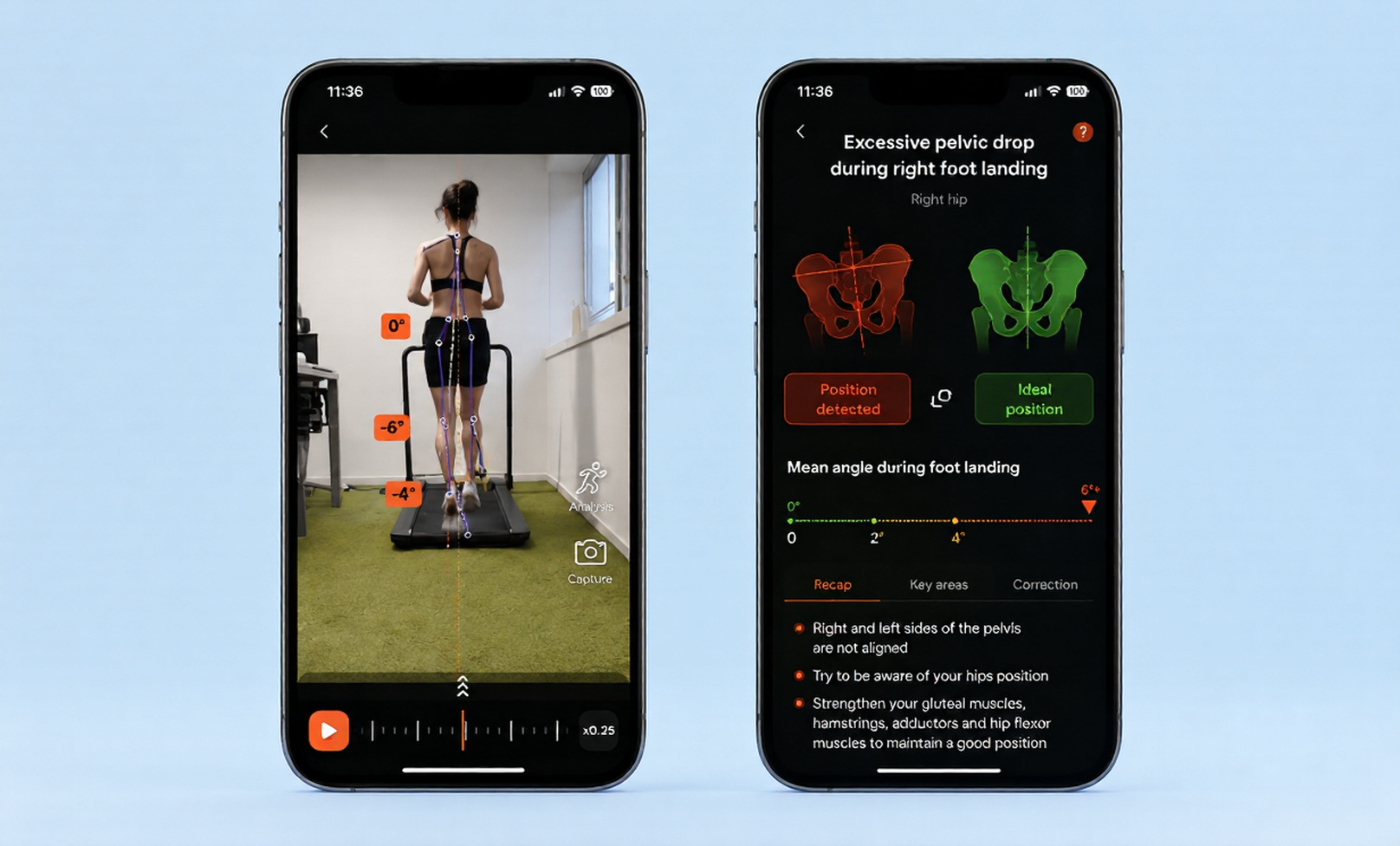
Select a case study below to view its video analysis, real-time biomechanical telemetry metrics, pelvic & spine tracking graphics, and clinical pedorthist insights.
Both methods lead to the same place: a clearer picture of your feet, how they function, and the right recommendation for your comfort and better long-term foot health. Here's who tends to feel most at home with each.
My custom orthotic solutions have proven to improve one’s foot health in as little as 6-months to a year. So whether I’m using the traditional pedograph analysis I've trusted for over twenty-five years, or the newest AI assisted gait analysis system allowing us to see the body in motion and fine-tuning your custom orthotics to meet your goals with the help of the latest in technology, my goal never changes: to see exactly how you move, so we can help you move better, with more comfort and less pain, all while improving how your feet function. That’s the real key to less pain and more comfort: better foot function creates better foot health. I guarantee it!
Kathy Carandang — Founder & Board Certified Pedorthist, WalkEZstoreA pedograph captures a static pressure impression of your foot, taken while standing or stepping onto a pressure-sensitive pad. It shows your arch type and how weight is distributed across your foot as you take that step, giving our pedorthist a clear starting point for understanding your foot mechanics.
AI uses computer vision and artificial intelligence to analyze walking or running mechanics from smartphone video. It tracks your joint angles, foot strike pattern, and stride in real time, giving a dynamic, in-motion picture of your biomechanics.
Not at all. Both the traditional pedograph and the new AI-Powered gait analysis are completely non-invasive — you simply stand, step, walk, or run normally while the assessment is taken.
Most gait analyses, whether pedograph or AI-Powered, take just a few minutes, and become an integral part of your in-store consultation.
Yes. Understanding your arch type, pressure points, and walking pattern helps our team recommend the right custom orthotic and/or footwear support for conditions like plantar fasciitis, over- and under- pronation, heel pain, and leg length discrepancies, and foot deformities(whether congenital or acquired), which can all contribute to foot pain issues.
Yes, both gait analysis methods are available exclusively by appointment only to give you the undivided attention you deserve.
Overpronation is when the foot rolls inward more than the typical 15% during the gait cycle, often linked to flatter arches. It can increase strain on the arch, ankle, and knee over time if left unsupported.
Pronation is the natural inward roll of the foot after heel strike, which helps absorb shock. Supination, or underpronation, is when the foot rolls outward instead, which is more common with higher arches and can reduce natural shock absorption.
Running gait includes a flight phase where both feet leave the ground, which never happens while walking. This means running places roughly two to three times your body weight in impact force through each foot, compared to about 1.2 times while walking, making foot strike pattern and support especially important for runners.
Yes. Children's gait patterns change as they grow, and an early assessment can identify biomechanical issues like in-toeing, out-toeing, or flat feet, and predispositions to inherited foot conditions before they become long-term concerns.
Yes. Bringing the shoes you wear most often — whether for work, exercise, or daily walking — helps our team understand how your footwear interacts with your movement patterns. Their wear patterns will confirm some of the findings of the foot gait analysis.
Absolutely. Athletes and runners benefit from understanding their foot strike pattern, joint symmetry, and movement efficiency, which can help reduce injury risk and improve performance over time. Many say that seeing their body in motion and getting the analysis helps them to consciously move better.
Coverage varies by plan. We recommend contacting your insurance provider to confirm whether a biomechanical gait assessment is included under your policy. Our team can provide any documentation you need, but we do not file insurance for you. Our company is a private pay source for your foot health care needs. However, many of today’s HRA(health reimbursement account) and HSA(health savings account) cards process just like a traditional credit card without any problems. It’s advised to check with your insurance company to be sure. We also accept Care Credit and Affirm for your convenience.