That unpleasant feeling in the inside front of your shin after walking just a bit too much is a common experience when you work on your feet. It is a common complaint we hear at WalkEZstore, and the good news is that it is manageable in most mild-to-moderate cases. You also don’t have to guess your way through it. Let’s look at what is going on in your leg and what causes it. We will also look at where footwear fits into the recovery picture. It is a support tool, not a magical solution.
Quick Answer: Shin splints (medial tibial stress syndrome) are caused by stress that becomes repetitive on the shinbone and muscles that surround it, and often occur because of over-pronation, worn-out footwear, or a rapid change in activity. Supportive footwear that contains a rocker sole and has a proper heel-to-toe drop with some motion control features is going to help reduce the strain during recovery. It is very important to remember that footwear is a supportive tool. If you are in pain that is persistent or that becomes severe, then you absolutely need to go and see a doctor or a podiatrist in order to rule out a stress fracture.
What Are Shin Splints, Exactly?
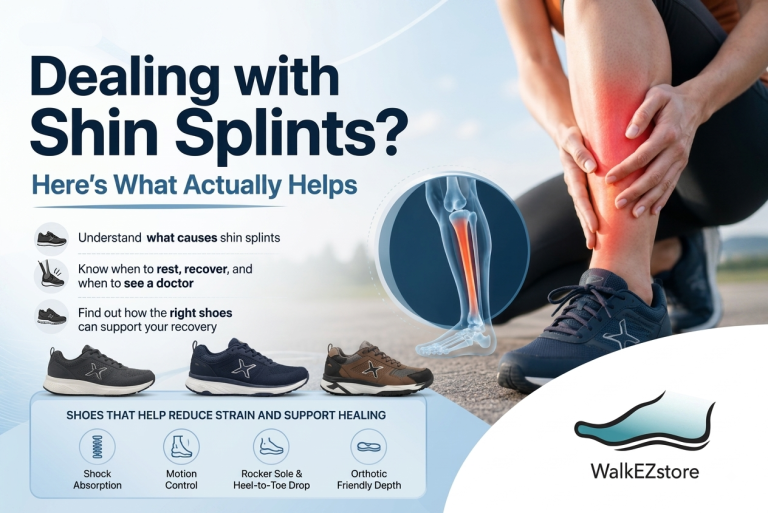
Shin splints are the common medial tibial stress syndrome (MTSS). It refers to pain that occurs along the edges of the inner shin bone. It is caused by an inflammation of the muscles and tendons that surround the bone and the bone tissue in the area. It is one of the overuse injuries that is most frequently seen in those who run, walk, or are employed and spend long hours standing on their feet.
What Causes Shin Splints?
Shin splints don’t just happen. They develop over time due to stress on the lower leg. Here are the probable causes:
- Overpronation, which is the excessive inward rolling of the foot while walking or running (this is considered a gait abnormality)
- Footwear that is old or no longer supportive or cushioned
- A rapid increase in workout intensity or volume. This is referred to as “too much too soon.”
- Either very flat feet or extremely rigid high arches
- Walking or running on hard and rough terrain
- Tight or weak calf muscles or a tight Achilles tendon
What Symptoms Should You Look For?
Symptoms of shin splints include:
- A dull ache that runs along the inner shin and is aggravated by activity
- Swelling in the lower leg
- Tenderness along the shin
- Pain that is relieved with rest but returns after activity
When Should You Go to the Doctor?
Shoes and self-care are helpful for the recovery of mild-moderate shin splints, but will not replace the need for a medical evaluation. You should see a doctor for shin splints if you develop any of the following:
- A stress fracture is a possibility if you have localized pain (that is no longer a dull ache)
- Pain that is of a greater intensity at rest or that is of a greater intensity during the night.
- Pain that is accompanied by swelling, redness, or heat in the shin
- Pain that makes walking or partial weight bearing difficult or impossible
So Where Do Shoes Actually Fit In?
While the right pair of shoes still won’t cure shin splints, they can help support your body and lessen the strain on your leg while the rest of your body heals. Podiatrists and pedorthists generally seek shoes that have:
- Some level of shock absorption to lessen impact on the lower leg
- Some control of motion to help those whose overpronation adds to their symptoms
- A rocker sole or an optimized heel-to-toe drop that helps lessen the strain on the tibialis anterior and the Achilles tendon during the gait cycle
- Some room for orthotics because many of the cases of shin splints are due to the foot’s mechanics
Spotlight: How Xelero Footwear Technology Addresses Shin Splint Triggers
Many of our customers, once they understand the mechanics of what is causing their pain, land at this conclusion. Xelero Performance Footwear has several of the biomechanical factors of shin splints built into the shoes:
The Swiss-engineered Rocker System.
Unlike many of the other running shoe styles that have an external rocker shape, Xelero shoes have a Swiss-engineered rocker system built directly into the midsole. This internal construction is designed to help lessen the stress on the leg and calf muscles during the gait cycle and is further evidenced in clinical insights from the Lower Extremity Review that propose this type of construction can help support relief of overuse symptoms such as shin splints.
Heel-to-Toe Drop
Some models, like the Xelero Matrix and Xelero Genesis XPS, have an 11mm–13mm midsole drop. These models help mechanically unload the tibialis anterior and the Achilles tendon by shifting the impact load to the thigh and hip muscles.
Guidance Propulsion System
Incorporated in the design, a carbon fiber “Slingshot plate” has similar functions to Morton’s toe extension when used in orthotics. This plate provides torsion control and encourages appropriate first ray function to the great toe. This plate will help lock the rear foot in a neutral position through the stride for the person who has shin splints caused by overpronation.
Orthotic Friendly Extra Depth
All Xelero models contain extra depth and have two removable insole layers, leaving extra space for custom orthotics to slide in. Additionally, if the toe box feels overly spacious, the orthotic can be used, and the filler insole can be put in for a better fit.
Xelero Matrix (Mesh or Leather)
This model has a 13mm heel drop and a wide, straight platform, built for maximum control for a side-to-side motion. This model suits a flat foot or a highly flexible foot and has the space for bunions or toe deformities.
Xelero Genesis XPS
This model is a lighter athletic trainer with an 11mm drop and a plush midsole with impact absorption foam. This model is best used for walking and light use on the road.
Steadfast (Mesh, Leather, or Hiker)
Softer than the Matrix or Genesis XPS by about 10 degrees in the midsole. Steadfast is balanced midsole-wise by a dynamic metatarsal roll bar that provides flowing support. A thicker, single-layer gel footbed is more integrated to the midsole, footbed, and insert combined into one piece. Every Steadfast, no matter the fabric upper option, comes with a reinforced toe box and a molded heel counter. The Steadfast II, while maintaining the structural support, is a good option if you’re not used to a firm shoe. The Steadfast Hiker and Trail versions are rugged, with a lugged rubber outsole, Aquamax waterproof and seam-sealed bootie construction, and the Steadfast Fitgo features a push and twist dial lacing system for easy on and off, especially good for those with limited hand dexterity.
Xelero X-GPS
Dual-layer “X-Lite” midsole construction is designed primarily for road use, cushions and speeds up the transition from heel to toe, and includes a built-in shoehorn. The X-GPS-WP is for wet conditions or slip-sensitive work, with a non-slip sole and a Gore-Tex waterproof lining.
Xelero shoes, unlike typical running shoes (often less than 12 ounces), are noticeably heavier due to being reinforced with control plates and stabilizing materials. However, they are good for recovery. They’re a strong choice for recovery walks, active healing, and long hours on your feet at work. Once healed, a lighter, max-cushion shoe may be a good option for distance running and track workouts.
Expert Insight
“The mechanics of the person with shin splints is likely at fault before the shoe is. Supportive shoes may provide pain relief. If pain is not improving or getting worse with supportive shoes and rest, then you can assume the person needs further evaluation and is not going to benefit from more supportive shoes.” — Kathy Carandang, Board Certified Pedorthist, WalkEZstore.
Frequently Asked Questions
What shoes are best for managing shin splints?
If shin splint pain is no longer dull but sharp. Suppose the pain occurs while at rest or worsens at night. If it’s severe enough that walking is difficult, don’t self-treat. Go to either a doctor or a podiatrist to rule out a stress fracture and other injuries.
No. While supportive shoes may help reduce some of the stress and strain on the shins, they are not a substitute for a medical diagnosis or the rest and therapeutic exercises that are needed.
Since Xelero shoes have a rocker sole system, a high heel-to-toe drop, a torsion-control plate, and a depth that is orthotic-friendly, they address a number of different mechanical issues that cause shin splint pain. Thus, while they are a good supportive shoe for the recovery process, they are not a recovery shoe.
For a lot of people, overpronators in particular, using custom orthotics and a supportive depth shoe may help reduce the mechanics that are causing shin splints. A pedorthist or podiatrist can help you determine if they are needed.
If shin splint pain is no longer dull but sharp. Suppose the pain occurs while at rest or worsens at night. If it’s severe enough that walking is difficult, don’t self-treat. Go to either a doctor or a podiatrist to rule out a stress fracture and other injuries.
In conclusion
If your shin splints are on the mild or moderate end of the spectrum and nothing worse has been ruled out, adjusting your shoes is your best next option. This is especially true if the pain is due to old shoes or overpronation. Xelero creates shoes with orthotic-friendly depth, a built-in rocker, and control of the motion and heel-to-toe. Their shoes are built with recovery to help their customers in mind.
Check out Xelero Performance Footwear at the WalkEZstore. If you’re unsure what model to buy for your needs, book your consultation with us. We are happy to assist.