How do you know? Have you noticed when walking with wet feet across concrete or sand that your foot’s impression doesn’t appear to have an arch? Or have you had a doctor, podiatrist, or certified pedorthist tell you that you have flat feet?
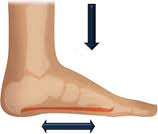
Your foot actually has three arches that help support and redistribute your body’s weight when standing, providing strength and stability. The arches also absorb the force of your body’s weight when walking and running. Your arches have to be sturdy and flexible to adapt to the various surfaces we walk on and to the stresses we put on our feet.
What Are Flat Feet?
When we’re infants and toddlers, we often have flat feet because our feet are developing during this period. However, some people don’t develop arches, usually due to genetics. For others, as we get older, the arches can collapse due to a traumatic injury to the foot or ankle or from everyday stress on our feet. People with flat feet or fallen arches may have no arches or very low arches.
Some risk factors that may increase your likelihood of developing flat feet include:
- Family history of fallen arches
- History of hyperflexible ligaments and tendons, EDS

- Posterior tibial tendon tear or dysfunction
- Aging
- Obesity
- Diabetes
- Pregnancy
- Rheumatoid arthritis
- Nervous system or muscular diseases, like cerebral palsy, muscular dystrophy, or spina bifida
People with flat feet often have overpronation, or excessive pronation. This condition causes the heel or ankle to tip inward when you’re standing or walking. The muscles in your lower legs will pull, and your knees will turn inward (also called knock-kneed). Plus, your feet may point outwards.
While some people with flat feet or very low arches may experience no problems, most people will have decreased stability in the knees, a shortened stride, and poorer balance. Eventually, they’ll suffer from knee, hip, and lower back pain. Overpronation can also lead to heel pain, arch pain, plantar fasciitis, heel spurs, and tendonitis.
Because of the uneven distribution of body weight, you may find that the heels of your shoes wear out more quickly, and more on one side than the other.
What Can You Do?
First, you should have your feet and gait evaluated by a certified professional to determine if you have flat feet or overpronation.
If you do suffer from flat feet pain:
You should wear supportive, well-fitted shoes. Please take a look at our Shoe Fitting Guide for more information. Also, extra-wide fitting shoes can improve symptoms.
Custom orthotics, like the ezWalker® Performance Insole, provide the arch support you need to correct overpronation, flat feet, or fallen arches. These insoles strategically raise the medial, lateral, and trans-metatarsal arches of your feet to provide you with proper bio-mechanical support. Your feet will be guided to walk from lateral heel to medial forefoot. And since your feet will be biomechanically better aligned, each step will be controlled throughout the gait cycle, reducing stress and strain on your feet, knees, hips, and/or lower back. ezWalker® Performance Insoles will help you maintain balance, stability, and proper posture – while providing pain relief.
Since the introduction of the ezWalker® Performance Insole in 2008, many people have reported improved foot health. Most cases show improvement in about 1 year, although improvement has been proven in as little as 6 months.
For more information on how ezWalker® Performance Insoles can improve your foot mechanics, contact us today. To order your pair of performance insoles, visit our online shop.
Because … when your feet feel good, you feel good.